Subterranean termite treatment in Prescott requires precision engineering due to the region's transitional terrain, shifting from decomposed granite basins in the Granite Dells to pine needle humic layers in Timber…
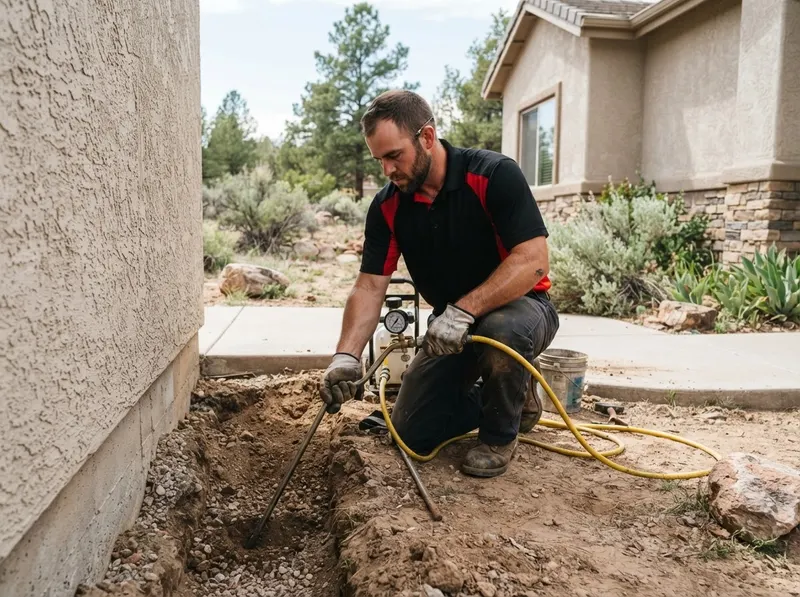
Subterranean termite treatment in Prescott requires precision engineering due to the region's transitional terrain, shifting from decomposed granite basins in the Granite Dells to pine needle humic layers in Timber Ridge and Hassayampa Village Community. Western subterranean termites forage through subterranean soil voids and construct earthen shelter tubes over concrete stem walls to reach structural sill plates and interior wall studs. Standard surface spraying fails because worker termites forage beneath the soil line. Elimination requires saturation of the exterior perimeter trench, creating a continuous zone of non-repellent termiticide such as fipronil at a labeled 0.06% concentration, which foragers transfer throughout the subterranean colony structure without detection.
Properties constructed on monolithic slabs, split levels, or stem walls across neighborhoods like Prescott Lakes, Pinon Oaks, and Cliff Rose require specialized injection protocols. Where exterior slabs, porches, or driveways abut living spaces, technical technicians drill half-inch holes spaced 12 inches apart through the concrete flatwork to access the underlying backfill. If an active infestation is isolated to an interior plumbing penetration or bath trap, a localized injection arrests structural damage, though whole-perimeter defense is required to protect untreated linear footages. The technical trade-off involves localized spot mitigation versus complete perimeter protection: spot applications address immediate structural compromise at a lower upfront cost, whereas full-perimeter defense establishes an uninterrupted subterranean barrier around the entire foundation envelope.
In acreage settings such as American Ranch, Talking Rock, and Hidden Valley Ranch, crawl spaces and dry stacked stone footings introduce distinct structural conduits. Foundation stem walls must be rod-injected to reach deeper soil strata where subterranean colonies retreat during freeze cycles at 5,300 feet elevation. Liquid barrier solutions bind to Prescott's mineral-dense soil profile, preventing leaching while maintaining lethal transfer zones for five years or more. Structural inspections include examining floor joists, mudsills near crawl space vents, and drywall nail heads near baseboards, ensuring zero active moisture conduits remain unmitigated.
Every job gets a firm, written price after a free on-site visit.
Tell us about your subterranean termite treatment job in Prescott and we'll send a clear, written quote, usually the same day.
 Ravelo Pest Elimination