Stinging insect activity in Prescott spikes sharply between May and October when paper wasps (*Polistes*) and western yellowjackets (*Vespula pensylvanica*) establish nesting colonies under structural overhangs,…
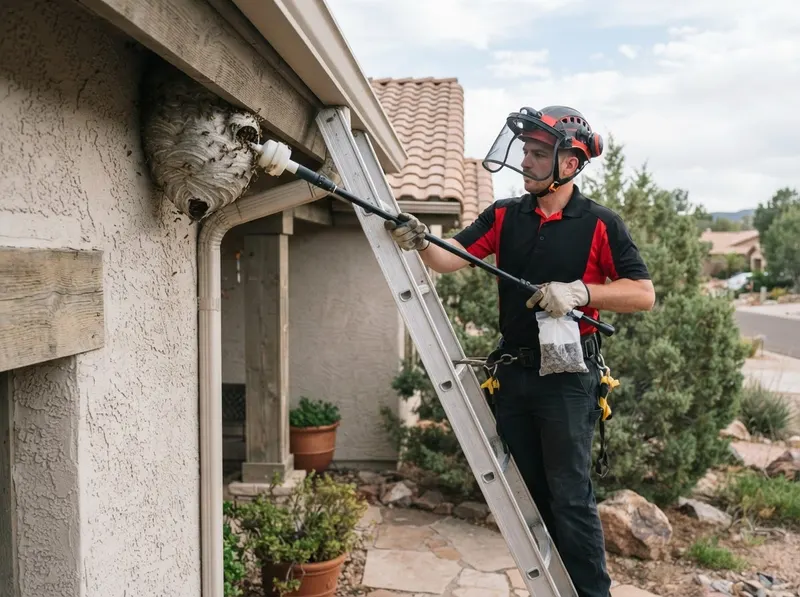
Stinging insect activity in Prescott spikes sharply between May and October when paper wasps (*Polistes*) and western yellowjackets (*Vespula pensylvanica*) establish nesting colonies under structural overhangs, decorative corbels, and granite boulder retaining walls. Nest locations vary by microclimate: properties in Pinon Oaks and Cliff Rose frequently host paper wasp clusters inside cedar fascia and open rafter tails, while shaded pine terrain in Timber Ridge and Hassayampa Village Community sees high volumes of subterranean and rock-void yellowjacket burrows. Wasps and hornet nest removal resolves the immediate sting hazard by applying micro-encapsulated knockdown agents directly to the primary comb before mechanical removal, preventing defensive colony dispersal into outdoor living zones.
Selecting professional nest extraction prevents structural entry. Untreated colonies in roof eaves above Courthouse Plaza or Historic Downtown Prescott regularly migrate through soffit gaps into attic insulation, turning an exterior hazard into an interior home infestation. If a nest is located on an exposed outer fascia under 12 feet, targeted topical knockdown and physical scraper removal clears the structure cleanly. If a yellowjacket colony enters weep screeds or wall voids, frequent along stone veneer homes in American Ranch and Talking Rock, direct aerosol flushing into the wall cavity without nest extraction forces worker wasps into the home's drywall, requiring specialized dual-action dust formulations instead.
Treatment execution follows three distinct technical steps: 1. Visual identification of the entry gallery or aerial comb to calculate colony volume and flight patterns. 2. Low-pressure application of contact pyrethroid compounds directly into the comb envelope or void aperture to eliminate adult defenders. 3. Physical detachment and containment of the comb structure, followed by an application of micro-crystalline residual barrier dust to prevent pheromone-driven rebuilding on the same attachment site. The trade-off between exterior spray-only treatments and full mechanical removal centers on re-infestation: leaving a treated paper comb on an eave preserves chemical pheromone trails that attract secondary wasp queens the following spring, whereas full physical detachment eliminates the structural cue permanently.
Every job gets a firm, written price after a free on-site visit.
Tell us about your wasps and hornet nest removal job in Prescott and we'll send a clear, written quote, usually the same day.
 Ravelo Pest Elimination